

Once the brief is received, whether from an in-house researcher or an agency, a written proposal needs to be submitted to the sponsor. This proposal should convey an understanding of the issue, objectives, research method, and timeline.
Within the confines of this article, we shall delve into addressing the subsequent inquiries:
- What do you need to consider when writing a market research proposal?
- What is the structure of a market research proposal?
What do you need to consider when writing a market research proposal?
When formulating the proposal, it’s essential to balance the trade-off between quality, which pertains to the required information and its accuracy, and the considerations of cost and timeframe. Further elaboration on these four factors will be provided below.
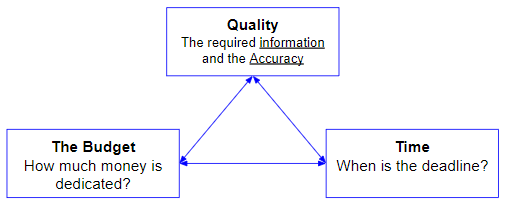
Adaptability will be necessary across various aspects of the project. As the research advances and insights are gained, modifications might be introduced to the initial goals and potentially to the specifics of the research plan. However, the majority of the interviews, which form the foundation of the cost, will generally remain consistent in terms of number and type.
The required information
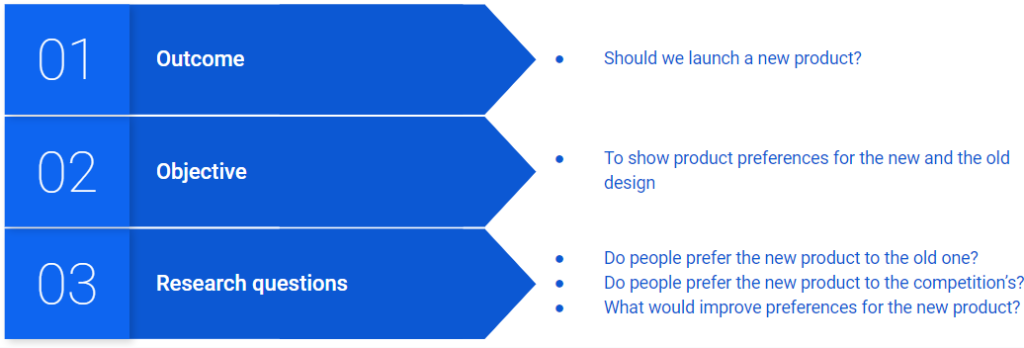
The researcher should synthesize the diverse inputs from the brief and reframe them as results, objectives, and the questions that will be posed. Refer to the illustration below:
The Accuracy
Understandably, the research sponsor will seek a pre-assessment of the statistical precision of the outcomes. Nevertheless, precision comes with a cost; typically, enhanced precision not only involves higher expenses but exhibits a disproportionate increase. Achieving an extremely high level of precision might not always be essential to fulfil the research goals. For instance, consider a scenario where a company is venturing into a new market with a widely perceived significant size – in this context, investing extensively to minutely gauge its size might not be practical.
The Budget
What amount should be allocated as a budget for the research endeavour? From a strictly methodological perspective, a researcher might assert that the budget should align with fulfilling the research goals and achieving the specified level of accuracy in information. Nevertheless, in real-world scenarios, it revolves more around the availability of funds or their compatibility with the project, taking into account other financial demands within the business. Moreover, even if financial resources are abundant, additional factors come into play, particularly the magnitude of risk associated with the decision that the research intends to inform.
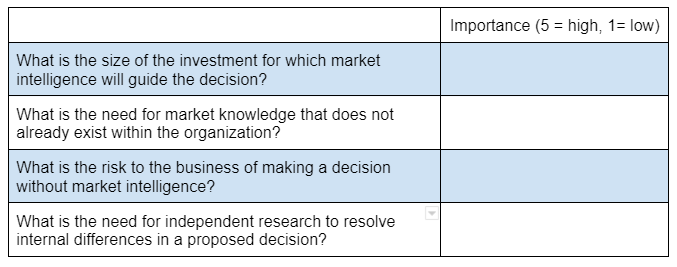
Inquiries to Evaluate the Return on Investment (ROI) of Market Research may include:
The Timetable
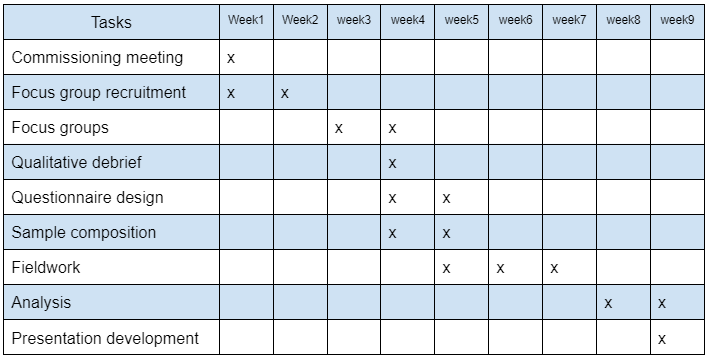
A research plan necessitates a schedule. The research might be constrained by external factors and schedules, like a business investment presentation or a business strategy timeline. There’s a possibility of expediting the research to align with these requirements. Undoubtedly, effective research can be executed within a brief period, yet there’s a threshold where quality could be threatened.
An example research timetable:
What is the structure of a market research proposal?
The proposal holds significant importance as a pivotal document in a researcher’s repertoire, often presented in formats like PowerPoint or Microsoft Word. Its content, arrangement, and calibre can substantially influence the decision to choose a market research firm, sometimes contributing to more than half of the decision-making process. Subsequent sections will provide insights into potential chapters that could be encompassed within a proposal.
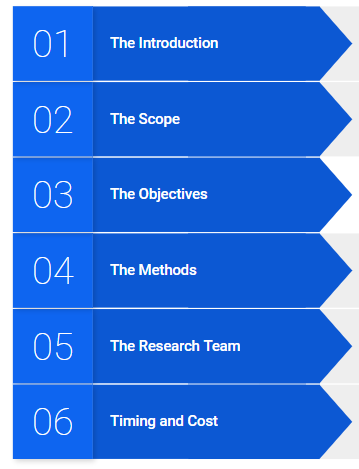
The Introduction
- Title page and table of contents.
- Start with a summary for longer proposals; otherwise, the initial page outlines the background and context prompting the research.
- Introduce findings from preliminary research or interviews to engage the reader and demonstrate interest, enhancing the proposal’s appeal.
The Scope
- Define the study scope before outlining objectives.
- Include geographical coverage and target respondent details.
- Consider specifying any areas or aspects that won’t be addressed.
The Objectives
- The objectives section is vital for the sponsor to ascertain ROI.
- Begin with a generic goal that defines the research’s purpose.
- Subsequently, outline the various detailed objectives.
The methods
- The methods section is crucial for the researcher, as the correct methods are pivotal for meeting the objectives.
- The client is concerned about methods, trust plays a role.
- The researcher’s expertise influences the client’s acceptance of methods.
- The methods section starts with an overview and design factors.
- Often includes varied methods like secondary research supporting fieldwork.
- Fieldwork might involve a qualitative phase, like depth interviews or focus groups.
- The quantitative stage is detailed, and the rationale for the interview method is explained.
- Sample size and respondent quotas are explicitly mentioned.
The research team
- Detail the research team credentials.
- Highlight the qualifications and expertise.
- Emphasize the experience in the field.
- Outline the responsibilities within the project.
Timing and cost
- The Timetable and Costs section is pivotal in deciding the project’s fate.
- Price is significant, but market research isn’t a commodity.
- Recognized differences among research suppliers.
- Not solely about the cheapest option winning.
- Common to provide a detailed cost breakdown to demonstrate composition.
References:
Hague, P. (2021). Market Research in Practice: An Introduction to Gaining Greater Market Insight. India: Kogan Page.


